Clean or Replace Pinball Steel Balls? Why the Ball Determines the Playing Surface, Gameplay, and Value Retention
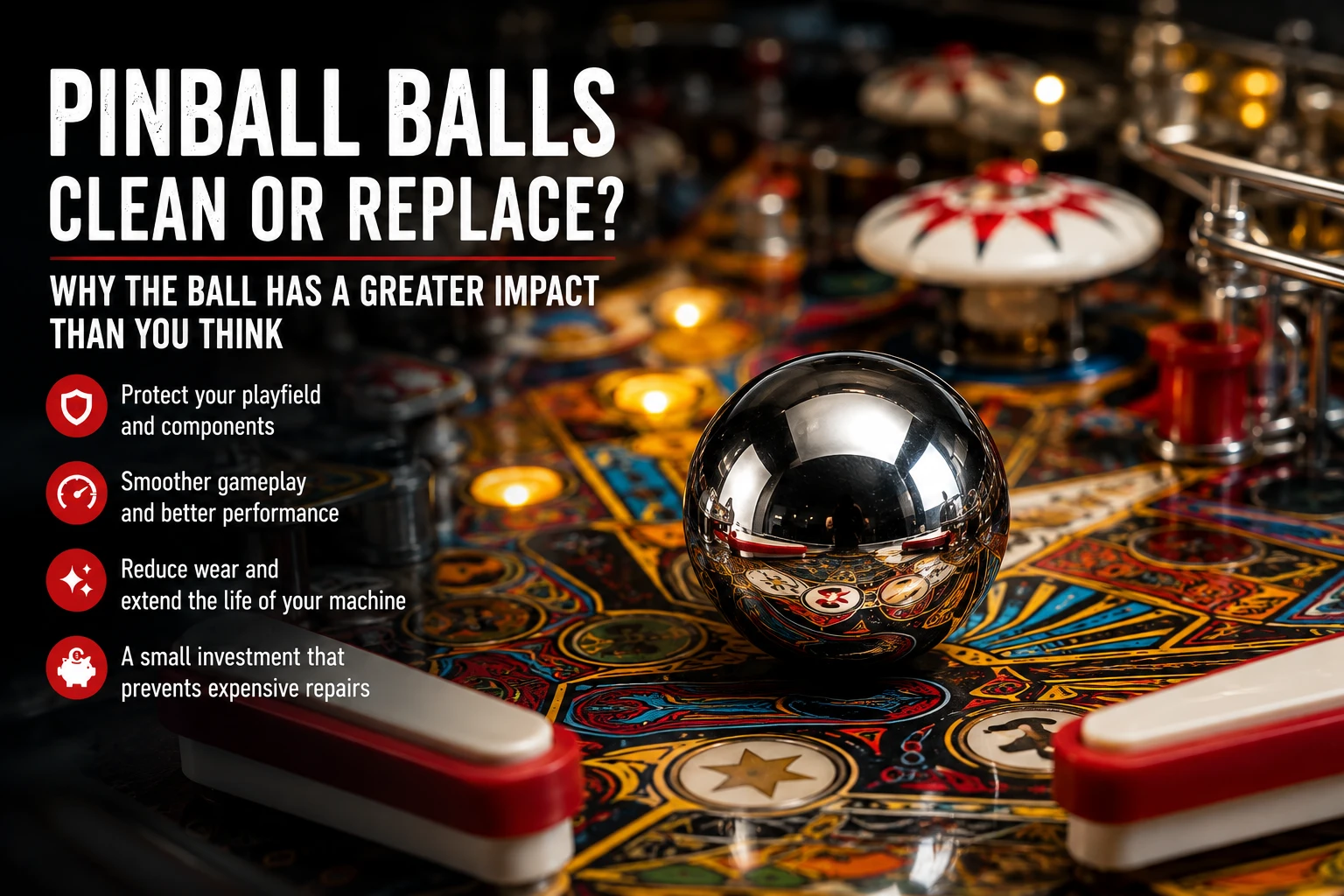
When people think about maintaining a pinball machine, they usually focus on rubber rings, flipper mechanisms, playfield cleaning or electronic components as flippercoils. One part is often overlooked, even though it comes into contact with almost every important component during every single game.
The pinball itself.
It rolls across the playfield, strikes bumpers, targets, ramps, wireforms, spinners, guides and flippers before eventually returning to the trough. Every impact creates friction, every movement transfers energy and every game leaves tiny traces on both the ball and the machine. Over thousands of games these small effects accumulate, making the condition of the ball far more important than most players realize.
For that reason, pinball balls are among the most important wear items in any machine.
In our workshop we regularly see machines fitted with balls that have been used for years. Many still appear reasonably shiny at first glance, yet a closer inspection reveals small scratches, dull spots or even the first signs of corrosion. Although these imperfections may seem insignificant, they can gradually increase wear on the playfield and many surrounding components.
A damaged pinball does not simply affect itself. Every time it rolls across the playfield it touches painted surfaces, metal guides, ramps, inserts, plastics and flipper bats. Tiny scratches or corrosion on the ball can act like very fine abrasive paper, slowly wearing away surfaces that are much more expensive to repair or replace than the ball itself.
Replacing a worn pinball is one of the simplest and most cost-effective maintenance tasks you can perform. Considering the value of today's pinball machines, it is a small investment that can significantly reduce long-term wear and help preserve both gameplay and resale value.
Why Pinball Balls Wear Over Time
At first glance, a hardened steel pinball appears almost indestructible. It is designed to withstand thousands of high-speed impacts while maintaining a perfectly smooth rolling surface. Nevertheless, every ball changes over time.
Each collision with a bumper, target, metal guide or flipper bat creates microscopic stresses on the surface. Initially these changes are invisible, but after many thousands of games tiny scratches, pressure marks and dull areas begin to develop. Environmental influences such as humidity, fingerprints or improper storage can further accelerate the process by allowing corrosion to form.
Viewed under magnification, the difference between a new precision ball and one that has seen years of service is remarkable. A new ball has a nearly flawless mirror finish, while an older one often shows microscopic scratches and irregularities. These imperfections increase friction and accelerate wear throughout the machine.
That is why it is good practice to inspect pinball balls regularly rather than waiting until obvious damage appears. Early replacement is far less expensive than repairing a worn playfield.
The Pinball Ball Touches Almost Every Component in Your Machine
Very few parts inside a pinball machine experience as much contact as the ball itself.
During a single game it rolls across the playfield, hits flipper bats, pop bumpers, slingshots, targets, spinners, wireforms, guides, ramps, inserts and plastics before finally returning to the ball trough. Because it interacts with almost every mechanical component, its condition directly influences both performance and wear.
A high-quality precision ball rolls more smoothly, produces less friction and collects less dirt during play. Many owners notice that their machine feels faster, smoother and more responsive immediately after installing a fresh set of balls. This is not simply perception—the improved surface finish genuinely reduces rolling resistance throughout the game.
For collectors who have invested significant time and money into restoring or preserving a machine, replacing worn pinball balls is one of the easiest ways to protect that investment.
Are All Pinball Balls the Same?
Many people assume that every pinball ball is identical because they all look similar. In reality, there are considerable differences in manufacturing quality, material consistency and surface finish.
High-quality precision balls are manufactured with extremely tight tolerances and polished to achieve a mirror-like surface. This allows them to roll consistently while minimizing friction and mechanical wear. Lower-quality or heavily worn balls often develop imperfections that negatively affect gameplay and increase long-term wear on the playfield.
Considering the relatively low price of a premium precision ball, choosing a high-quality product is one of the smartest maintenance decisions a pinball owner can make.
Which Ball Size Does My Pinball Machine Use?
Most modern and classic pinball machines use 1 1/16-inch (apprx. 27 mm) pinballs. This has become the industry standard and is used by manufacturers including Stern Pinball, Williams, Bally, Jersey Jack Pinball, Chicago Gaming Company, American Pinball, Data East, Sega and many others.
However, some older electromechanical machines and a small number of special models require different ball sizes. Before purchasing replacements, always check your machine's manual or the manufacturer's specifications to ensure the correct size is used.
Even a small difference in diameter can affect switch activation, ball guides and overall gameplay.
Cleaning or Replacing – Which Is Better?
Cleaning and replacing serve two different purposes.
Cleaning removes rubber dust, fingerprints and general contamination from the surface of the ball. When carried out with a soft microfiber cloth and a suitable cleaner, it helps maintain a smooth rolling surface and prevents dirt from spreading across the playfield.
Cleaning cannot, however, repair scratches, dents or corrosion. Once the surface has been damaged, polishing may temporarily improve the appearance but it cannot restore the original precision finish. The microscopic imperfections remain and continue to increase wear during gameplay.
For that reason, we consider cleaning to be routine maintenance, while replacing worn balls is an essential part of long-term machine preservation.

How Often Should Pinball Balls Be Replaced?
There is no universal replacement schedule that applies to every pinball machine. The right time to replace a ball depends primarily on how often the machine is played and, more importantly, on the condition of the ball itself.
A machine that is only played occasionally in a home game room will naturally put far less stress on its pinballs than one operating daily in a showroom, arcade or tournament environment. While commercial machines may see thousands of games within a few weeks, a privately owned machine might take years to reach the same number of plays.
For that reason, we do not recommend replacing pinball balls based solely on time. Instead, inspect them regularly. As soon as you notice dull areas, fine scratches, small dents or the first signs of corrosion, it is time to install a new precision ball. Waiting until damage becomes obvious only increases the risk of unnecessary wear to the playfield and other expensive components.
Many experienced collectors replace their pinballs before visible damage appears. Considering how inexpensive a new precision ball is compared to the cost of repairing an original playfield, it is a sensible investment in the long-term preservation of the machine.
Is Polishing a Pinball Ball Worth It?
This is one of the most frequently discussed topics in the pinball community. Some players recommend polishing old pinballs, while others replace them immediately. The truth lies somewhere in between.
Polishing can certainly improve the appearance of a pinball. Dirt, oxidation and light surface stains may disappear, leaving the ball looking cleaner and shinier than before. However, polishing cannot restore the original surface quality of a precision-manufactured pinball.
Once microscopic scratches, dents or corrosion have formed, they remain part of the metal. Even if these imperfections become less visible, they continue to affect how the ball rolls across the playfield. Under magnification, the difference between a polished used ball and a brand-new precision ball is immediately obvious.
For that reason, we view polishing as a cosmetic treatment rather than a permanent solution. If a pinball already shows signs of wear, replacing it will always provide better long-term protection for your machine.
A Common Misconception: "It's Steel, So It Can't Wear Out"
This is something we hear surprisingly often.
Because pinballs are made from hardened steel, many owners assume they will last indefinitely. While the material is extremely durable, it is not immune to wear. Every game subjects the ball to thousands of high-speed impacts against metal, plastic and painted wooden surfaces.
Over time, these repeated impacts gradually change the surface of the ball. The process happens so slowly that it often goes unnoticed, especially because players become accustomed to the way their machine feels.
Compare a brand-new precision ball with one that has been in service for several years and the differences become much easier to spot. The older ball usually has a duller finish, tiny scratches and small pressure marks that were almost impossible to notice during everyday play.
These seemingly minor imperfections are exactly what make regular inspections so important.
Your Playfield Benefits Just as Much as Your Gameplay
Many owners clean their playfield, replace worn rubber rings and carefully maintain every visible part of their machine. Yet the same pinball often remains in use for years.
Ironically, no single component comes into contact with the playfield more often than the ball itself.
A perfectly smooth precision ball rolls more consistently, creates less friction and carries less rubber dust across the playfield. The result is not only reduced wear but also a smoother, faster and more predictable playing experience.
This becomes particularly noticeable on restored machines or collectors' pieces with exceptionally well-preserved original playfields. In these cases, replacing pinballs regularly should be considered part of routine maintenance rather than an optional upgrade.
A Recommendation From Our Workshop
One principle has guided our workshop for years:
Replace pinball balls a little too early rather than a little too late.
A premium precision pinball costs only a fraction of what it would take to repair worn inserts, damaged ramps or an original playfield. The ball is one of the least expensive components in the entire machine, yet it has one of the greatest influences on long-term wear.
Many problems develop gradually and remain unnoticed until visible damage has already occurred. Taking a few seconds to inspect the ball during routine cleaning can help prevent costly repairs later on.
Simply hold each ball under a bright light and slowly rotate it. If the surface remains perfectly smooth and mirror-like, it is ready for many more games. If you notice dull areas, scratches, rust or pressure marks, replacing the ball is usually the safest and most economical decision.
Regular inspection, proper cleaning and timely replacement are small maintenance tasks that help preserve your pinball machine for years to come while ensuring that every game feels exactly as the designer intended.
FAQ´s Pinball Steel Balls
How often should I replace the pinball balls in my machine?
There is no fixed replacement interval. The right time depends on how often the machine is played and the condition of the balls. If you notice scratches, dull spots, rust or dents, replacing the balls is recommended to protect your playfield and mechanical components.
Can I clean pinball balls instead of replacing them?
Yes, if the balls only have dirt, fingerprints or rubber residue on the surface. However, cleaning cannot repair scratches, dents or corrosion. Once the surface is damaged, replacing the ball with a new precision pinball is the better long-term solution.
Can worn pinball balls damage the playfield?
Yes. Even microscopic scratches or corrosion can increase friction and accelerate wear on the playfield, ramps, metal guides and many other components. Replacing worn balls early helps prevent unnecessary damage.
How can I tell if a pinball ball should be replaced?
Hold the ball under a bright light and slowly rotate it. Dull areas, rust, scratches or visible dents are clear signs that the surface is no longer in optimal condition and the ball should be replaced.
What is the standard pinball ball size?
Most modern and classic pinball machines use 1 1/16-inch (26.99 mm) pinballs. Some older or special machines use different sizes, so always check your owner's manual before ordering replacements.
Do new pinball balls improve gameplay?
Yes. A new precision pinball rolls more smoothly, creates less friction and often makes the game feel faster, more consistent and more responsive.
Can I continue using rusty pinball balls?
No. Rust damages the ball's surface and significantly increases wear on the playfield and other mechanical parts. Rusty pinballs should always be replaced.
Is polishing old pinball balls worth it?
Polishing may restore some shine but cannot remove microscopic scratches, dents or corrosion. If the ball already shows signs of wear, replacing it with a new precision ball is the better choice.
Why are pinball balls considered wear parts?
During every game the ball comes into contact with almost every important component inside the machine. Thousands of impacts gradually change the surface, making regular inspection and replacement an important part of routine maintenance.
Which parts of the machine does the ball touch?
The pinball rolls across the playfield and comes into contact with flipper bats, ramps, pop bumpers, targets, spinners, wireforms, inserts, plastics, metal guides and the shooter lane. Its condition therefore affects the entire machine.
Why do experienced collectors replace pinball balls regularly?
A new precision ball costs very little compared to repairing a worn playfield or damaged components. Many collectors replace their pinballs before visible damage appears to preserve the condition and value of their machines.
Why should I choose high-quality precision pinballs?
Premium precision pinballs feature an exceptionally smooth surface and tight manufacturing tolerances. They roll more consistently, reduce friction and help minimize long-term wear throughout the machine.