LED or incandescent bulb? Which type of lighting is the better choice for pinball machines?
Lighting is one of the most important elements of a pinball machine. It not only ensures that the playfield is optimally illuminated, but also influences the entire gaming experience. Light guides the player’s gaze, skillfully highlights game mechanics, and plays a crucial role in creating the atmosphere of a pinball machine. Whether it’s a classic machine from the 1990s or a current model—without the right lighting, a pinball machine would have only a fraction of its impact.
Sooner or later, many owners face the question of whether to stick with classic incandescent bulbs or switch to modern LED lighting. This topic comes up time and again, especially during restoration or maintenance work. Opinions on this matter vary widely. While some prefer the warm character of the original lighting, others value the high luminosity, low power consumption, and long lifespan of modern LEDs.
There is no one-size-fits-all answer. Both types of lighting have their merits and offer different advantages and disadvantages depending on the pinball machine model and personal preferences. Anyone looking to make a decision should therefore not only consider brightness but also factors such as color temperature, heat generation, energy consumption, maintenance requirements, and technical compatibility.
In this article, we’ll highlight the key differences between LED and incandescent bulbs, explain their respective strengths and weaknesses, and provide practical tips for anyone looking to upgrade their pinball machine—whether technically or aesthetically.
Why Lighting Is So Important in a Pinball Machine
A pinball machine thrives on movement, sound, and light. Virtually every gameplay situation is enhanced by the lighting. Light sources mark targets, accompany animations, highlight specific game features, and ensure that important areas of the playfield remain clearly visible at all times.
Especially in older pinball machines, all lighting animations were designed to work with classic incandescent bulbs. The warm light creates a pleasant atmosphere and, for many collectors, is part of their machine’s original look. Modern pinball machines, on the other hand, are equipped almost exclusively with LED technology right from the factory. They enable significantly brighter effects, a wider range of colors, and elaborate light shows.
No matter which technology is used—proper lighting not only enhances the visual appeal but also improves the overall gaming experience. Well-lit ramps, targets, domes, and the general playfield lighting make it easier to navigate the game and give the pinball machine a more premium look and feel.
Classic incandescent bulbs—authentic and pleasantly warm
For many decades, incandescent bulbs were the standard lighting in pinball machines. Their warm light still defines the typical character of many classics from Williams, Bally, Gottlieb, Sega, and Data East.
Collectors and enthusiasts of faithful restorations, in particular, often make a conscious choice to use this technology. The colors appear softer, reflections are more subtle, and the entire playfield takes on a natural, harmonious appearance. Many older machines were designed specifically for these lighting characteristics.
However, incandescent bulbs also have some drawbacks. They generate significantly more heat than LEDs, consume more electricity, and have a comparatively short lifespan. Depending on usage, individual bulbs must be replaced regularly, especially in hard-to-reach areas under the playfield or in the backbox. Anyone who plays their pinball machine frequently should therefore always keep a few suitable replacement bulbs on hand.
Modern LED Lighting—Efficient, Durable, and Versatile
In recent years, LEDs have almost completely replaced traditional incandescent bulbs in many areas—including pinball machines. Modern LED bulbs offer high luminous efficacy, require significantly less energy, and generate considerably less heat. At the same time, they have a significantly longer lifespan, which substantially reduces maintenance requirements.
Owners of pinball machines that are played regularly benefit particularly from these features. While traditional incandescent bulbs must be replaced at regular intervals depending on their application, high-quality LEDs often last for many years. This not only saves time but also reduces the effort required to replace hard-to-reach bulbs under the playfield or in the backbox.
Another advantage lies in the wide selection of different light colors. From warm white to neutral white to cool white or vibrant colors like red, blue, green, or yellow, numerous options are available. This allows the appearance of a pinball machine to be customized without the need for further modifications.
LEDs can truly showcase their strengths, especially in modern pinball machines with elaborate light shows. Their high luminosity creates intense effects and makes the playfield, domes, and individual play areas appear much more high-contrast.
Warm White or Cool White—Color Temperature Makes All the Difference
Not every LED produces the same light. A common mistake is to focus solely on brightness. In fact, color temperature plays an equally important role.
- Warm-white LEDs produce light that closely resembles that of classic incandescent bulbs. They are particularly suitable for older Williams, Bally, Gottlieb, Sega, or Data East pinball machines when the machine’s original character should be preserved as much as possible.
- Neutral-white LEDs appear slightly clearer and are often used where the most natural illumination possible is desired.
- Cool-white LEDs, on the other hand, have a significantly higher blue component. They appear particularly bright and make colors appear more vivid. Modern pinball machines, in particular, often benefit from this lighting effect. With classic machines, however, some owners find cool-white light to be too cold or too sterile.
Choosing the right color temperature is therefore always a matter of personal taste and the specific pinball model.
Where exactly are LEDs and incandescent bulbs used in pinball machines?
A pinball machine has numerous different light sources, each serving a specific purpose. In addition to general playfield lighting—often referred to as General Illumination (GI)—individual game features are specifically highlighted.
These include, among other things, illuminated targets, ramp entrances, shooter lanes, backbox lighting, and various domes on the playfield. Depending on the pinball model, different lamp bases and sockets are used, which is why you should always make sure to use the correct type when replacing them.
Especially with older machines, it’s worth checking for worn sockets or corroded contacts as well. Not every flickering lamp is automatically defective—the cause is often dirty contacts or a poor connection.
Is it worth switching to LEDs?
There’s no one-size-fits-all answer to this question. Those who want to restore their pinball machine as faithfully as possible to its original state will often stick with classic incandescent bulbs. They’re part of the authentic look of many older machines and create exactly the lighting atmosphere originally intended by the manufacturer.
On the other hand, those who prioritize low-maintenance lighting, want to reduce power consumption, or achieve more vibrant colors will find modern LEDs to be an excellent alternative. High-quality LED bulbs stand out for their long service life and low heat output, which also reduces stress on surrounding plastic parts.
Many pinball owners therefore opt for a middle ground. While the general playfield lighting is intentionally equipped with warm-white LEDs, colored LEDs are used in specific play areas or on domes to highlight certain effects more prominently. This preserves the machine’s character while simultaneously taking advantage of modern technology.
Common Mistakes When Converting to LEDs
An LED conversion isn’t simply a matter of removing all incandescent bulbs and replacing them with LEDs. Depending on the pinball model, there may be different requirements for the light sources used.
Particularly inexpensive LEDs often differ in their light distribution. While incandescent bulbs emit light almost evenly in all directions, some LEDs have a very narrow beam angle. This can result in uneven illumination of certain areas of the playfield.
Excessive brightness isn’t always an advantage either. LEDs that are too bright can be glaring or make certain areas of the playfield look unnatural. Often, a balanced combination of different brightness levels and color temperatures yields a much more harmonious result.
That’s why it’s recommended to use only high-quality light sources and select them to suit the specific pinball machine model, rather than simply focusing on maximum brightness.
LEDs vs. Incandescent Bulbs—A Direct Comparison
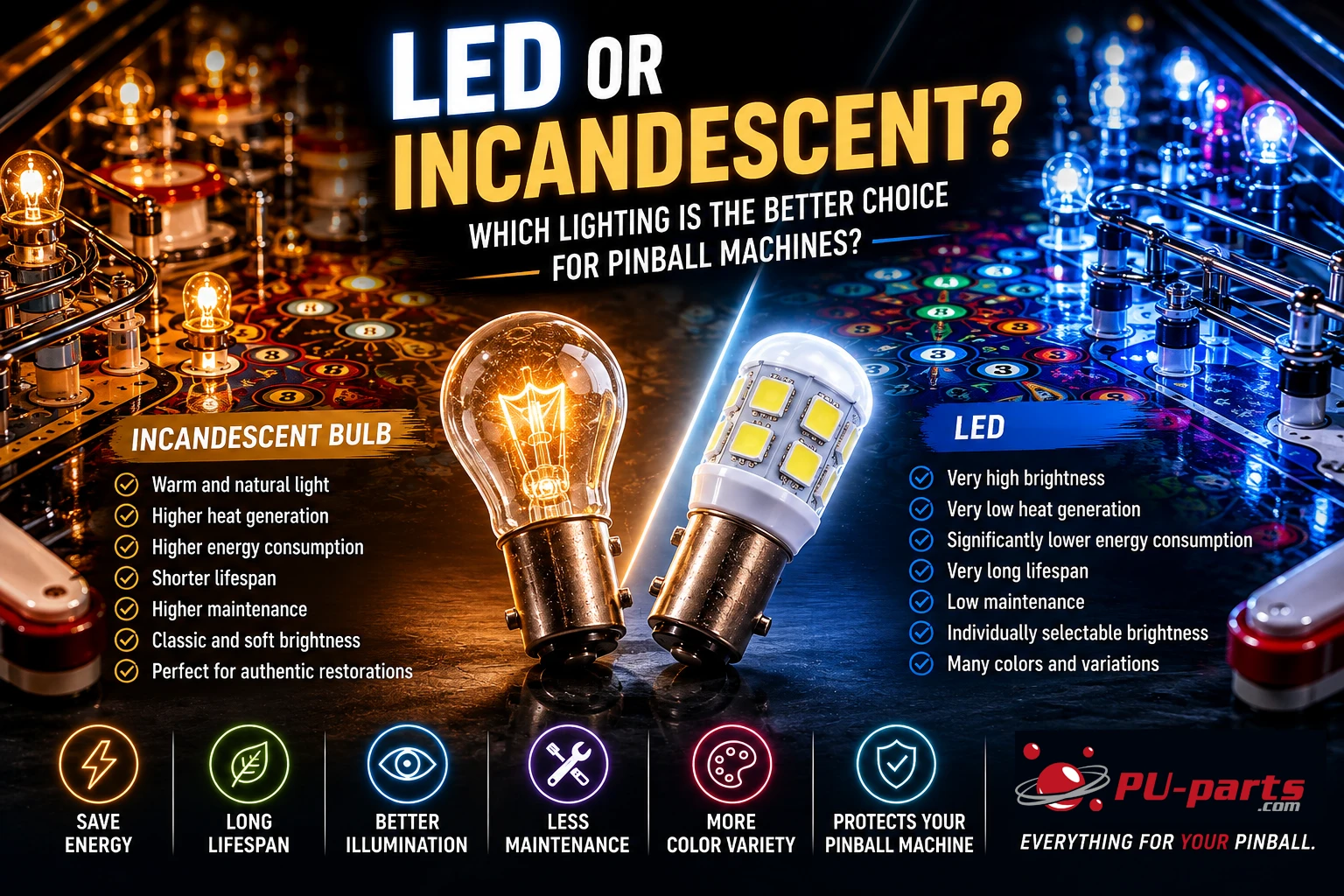
Both LEDs and traditional incandescent bulbs have their merits. Which lighting option is the better choice ultimately depends on your priorities. Do you want to keep your pinball machine as true to the original as possible, or are a long service life, low maintenance, and maximum brightness your top priorities?
Incandescent bulbs continue to impress with their pleasantly warm light and the authentic atmosphere they create, which really comes into its own, especially with classic pinball machines. Many collectors consider this very lighting effect to be part of the original gaming experience.
LEDs, on the other hand, offer numerous technical advantages. They consume significantly less energy, generate much less heat, and generally last many times longer than traditional incandescent bulbs. At the same time, they’re available in numerous colors and different brightness levels, allowing you to customize the appearance of a pinball machine.
Those who play their machines regularly or want to keep maintenance to a minimum will often opt for LEDs. Enthusiasts of authentic restorations, on the other hand, often continue to prefer classic incandescent bulbs.
| Feature | Incandescent Bulb | LED |
|---|---|---|
| Light color | Warm and natural | From warm white to cool white, plus many different colors |
| Energy consumption | Higher | Significantly lower |
| Heat generation | High | Very low |
| Lifespan | Comparatively short | Very long |
| Maintenance requirements | Higher | Low |
| Brightness | Classic and soft | Very bright and individually selectable |
| Originality | Perfect for authentic restorations | Ideal for modern upgrades |
Our Recommendation from the Workshop
There is no one-size-fits-all recommendation, as every pinball machine and every owner has different needs. However, our experience has shown that high-quality LEDs are an excellent choice for many applications. They significantly reduce maintenance requirements, relieve stress on various components thanks to their low heat output, and ensure even illumination of the playfield.
For classic collector’s items, on the other hand, it can make perfect sense to deliberately stick with incandescent bulbs. Especially when preserving the machine’s original historical condition, the characteristic lighting effect is often an integral part of the machine’s overall appearance.
Anyone deciding to retrofit their machine should not focus solely on maximum brightness. Far more important is the harmonious coordination of the individual light sources. Warm-white LEDs look significantly more natural in many older pinball machines than cool-white variants and often come very close to the original appearance. At the same time, colored LEDs can be used strategically to visually highlight individual play areas or domes without altering the machine’s overall character.
Equally important is the quality of the components used. High-quality LED bulbs, compatible lamp sockets, and intact lamp holders play a key role in ensuring that the lighting functions reliably and provides lasting enjoyment.
The right accessories also play an important role
In addition to the actual bulbs, many other components influence a pinball machine’s lighting system. Worn lamp sockets, oxidized lamp holders, or damaged contacts can cause individual lamps to flicker or fail completely. Before replacing bulbs, it’s therefore always worth checking the other components as well.
Depending on the pinball model, different lamp sockets and holders are used. Canopies and domes also serve far more than just a visual function. They distribute light evenly, protect the bulbs beneath them, and significantly influence the lighting effect on the playfield. Yellowed or damaged domes, in particular, can visibly reduce brightness and detract from the overall appearance of a pinball machine.
Anyone looking to modernize or repair their lighting system should therefore examine the entire system rather than simply replacing the bulbs themselves.
Lighting Affects More Than Just Appearance
The lighting in a pinball machine doesn’t just determine how the playfield looks. It also influences the gaming experience, orientation during play, and the machine’s overall impression. Whether you opt for classic incandescent bulbs or modern LEDs ultimately depends on your personal preferences and the specific pinball model.
Both technologies have their strengths. While incandescent bulbs impress with their warm and authentic light, LEDs stand out primarily for their high efficiency, long lifespan, and low maintenance requirements. By understanding the differences and carefully selecting the lighting, you can enhance your pinball machine both technically and visually in the long term.
Ghosting and Non-Ghosting – Why Some LEDs Continue to Glow
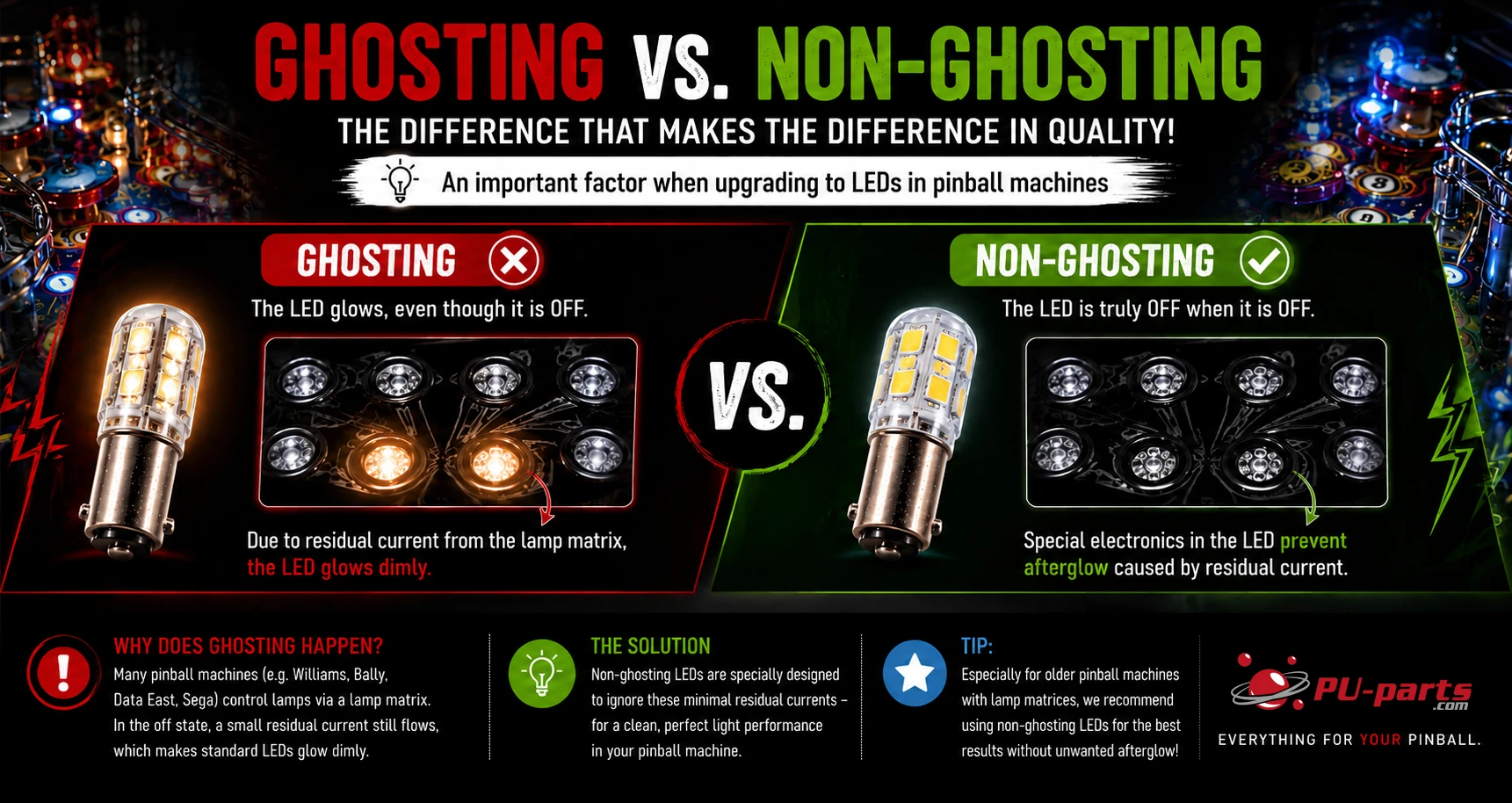
One issue that repeatedly causes confusion when converting to LED lighting is what’s known as ghosting. This refers to the slight afterglow or faint glow of individual LEDs, even though they should actually be turned off.
The reason for this is usually not a defect in the LED itself, but rather how the lights are controlled by the pinball machine’s electronics. In particular, many Williams, Bally, Data East, and Sega pinball machines control the lights via a so-called light matrix. Even when the lights are off, a very small residual current flows through individual light circuits.
Traditional incandescent bulbs do not react to this minimal current, as they require significantly more energy to glow. LEDs, on the other hand, are much more sensitive and can glow visibly even with these small residual currents.
The result is an undesirable effect in which individual lights glow faintly or flicker slightly all the time. This so-called “ghosting” is often particularly noticeable in darker rooms.
What does “non-ghosting” mean?
Non-ghosting LEDs refer to specially developed LED light sources that are designed not to react to these minimal residual currents. Additional electronic components inside the LED prevent the unwanted afterglow and ensure that the lamp only lights up when it is actively switched on by the pinball machine’s electronics.
This is why non-ghosting LEDs are often the better choice, especially for older pinball machines. They not only improve the machine’s appearance but also ensure clean light animations without distracting side effects.
When Should You Opt for Non-Ghosting LEDs?
Whether non-ghosting LEDs are necessary depends primarily on the specific pinball model and its lamp control system. While modern machines equipped with LED technology from the factory generally do not experience this problem, ghosting can occur, particularly in classic pinball machines with lamp matrices.
Anyone who wants to convert their pinball machine to LEDs and values the cleanest possible light display should therefore check whether non-ghosting LEDs are recommended for their specific model. High-quality LEDs designed specifically for pinball machines take these requirements into account and ensure a significantly more harmonious result.
FAQ´s - LED or Incandescent Bulbs
Are LEDs or incandescent bulbs better for a pinball machine?
That depends on your pinball machine and the result you want to achieve. Incandescent bulbs provide a warm, classic look and are ideal for authentic restorations. LEDs consume less power, generate less heat, last significantly longer, and are available in a wide range of colors and brightness levels.
Is it worth upgrading a pinball machine to LEDs?
For many pinball owners, the answer is yes. LED upgrades reduce maintenance, lower power consumption, and generate much less heat than traditional bulbs. Choosing high-quality LEDs with the correct socket type and light characteristics is essential for the best results.
Which LED color temperature is best for classic pinball machines?
Warm white LEDs are often the best choice for classic Williams, Bally, Gottlieb, Sega, and Data East pinball machines because they closely resemble the warm appearance of traditional incandescent bulbs. Cool white LEDs appear brighter but may look too modern for vintage games.
What is LED ghosting in a pinball machine?
Ghosting describes a situation where an LED glows faintly even though it should be switched off. This is usually caused by small residual currents within the lamp matrix that are strong enough to activate sensitive LEDs but not traditional incandescent bulbs.
What are non-ghosting LEDs?
Non-ghosting LEDs are specially designed to prevent unwanted afterglow caused by residual current in the lamp matrix. Their integrated electronics ensure the LED remains completely off when it is not being actively powered.
Does every older pinball machine require non-ghosting LEDs?
No. Whether non-ghosting LEDs are necessary depends on the machine's lamp matrix design and electronics. Some machines work perfectly with standard LEDs, while others may experience ghosting or flickering.
Why do LEDs flicker in a pinball machine?
Flickering can be caused by poor electrical contacts, oxidized lamp sockets, unsuitable LEDs, loose connectors, or the way the lamp matrix is controlled. Always inspect both the LED and the surrounding electrical components.
Can every incandescent bulb simply be replaced with an LED?
Not always. Socket type, physical size, operating voltage, polarity, beam angle, and available installation space must all match the specific application inside your pinball machine.
Do LEDs generate less heat than incandescent bulbs?
Yes. LEDs produce considerably less heat, helping to protect nearby plastic components, lamp domes, caps, and other heat-sensitive parts inside the machine.
Why is the LED beam angle important?
Incandescent bulbs distribute light evenly in almost every direction, while some LEDs focus their light into a narrower beam. Choosing the wrong LED may result in bright spots, shadows, or uneven illumination across the playfield.
Can LEDs that are too bright reduce the visual quality of a pinball machine?
Yes. Extremely bright LEDs can create glare, wash out artwork, or make certain areas appear unnatural. A balanced combination of brightness, color temperature, and light distribution usually provides the best visual result.
Why should lamp sockets also be inspected?
Corroded contacts, worn sockets, or loose lamp holders can cause flickering, intermittent operation, or poor electrical contact. Replacing the bulb alone will not solve these issues.
What is the purpose of lamp domes and caps in a pinball machine?
Lamp domes and caps protect the light source while also influencing light distribution and color appearance. Yellowed or damaged domes can noticeably reduce brightness and affect the overall look of the playfield.
Can LEDs and incandescent bulbs be used together in the same pinball machine?
Yes. Many owners use a mixed lighting setup. Warm white LEDs can be installed in frequently serviced areas, while incandescent bulbs remain in selected locations to preserve the machine's original appearance.