Flipper Bats – Structure, Function, Adjustment, and Common Problems
The flipper is one of the most recognizable components of a pinball machine. For the player, it is the most important tool for shooting the ball precisely across the playfield, hitting ramps, and keeping the ball in play as long as possible. What looks like a relatively simple plastic part when viewed from above is, however, only the visible part of a much more complex mechanism located beneath the playfield.
When the player presses the pinball button on the cabinet, a whole sequence of electrical and mechanical processes is triggered within a very short time. A pinball solenoid generates the necessary force, a piston begins to move, and the pinball mechanism transfers this linear motion to the pinball shaft. This causes the flipper finger to rotate upward at high speed and accelerate the ball. It is precisely this enormous strain that makes the pinball mechanism an area that should be regularly maintained. A flipper finger performs countless movements during a game. As operating time increases, sleeves, plungers, joints, stops, bushings, and other components can therefore wear out.
What is a flipper finger (also called flipper bat) ?
A flipper finger is the movable plastic arm on the playfield that the player uses to control and accelerate the pinball. In the English-speaking pinball community, it is usually simply referred to as a flipper or flipper bat. The visible flipper finger is mounted on a shaft that runs through the playfield. Beneath the playfield, this shaft is connected to the actual pinball mechanism. When the mechanism is activated, the shaft rotates, and with it, the flipper finger.
After the player releases the flipper button, the mechanism ensures that the finger quickly and reliably returns to its starting position. Thus, the flipper finger performs two key functions: It allows the player to actively control the ball and, at the same time, must transmit sufficient force to rapidly accelerate a heavy steel ball within fractions of a second.
Why are flipper fingers so important for the feel of the game?
Hardly any other component influences the feel of a pinball machine so directly. Even slight differences in force, return, angle, or play in the mechanism can be clearly noticeable. A technically flawless flipper finger moves quickly, powerfully, and consistently. It reliably reaches its intended end position and returns immediately after being released.
If, on the other hand, the mechanism is worn or stiff, the pinball can feel sluggish. Ramps that are normally easy to hit suddenly become harder to reach. Controlled techniques such as holding the ball or directing it precisely can also be compromised as a result.
The problem becomes particularly noticeable with two main flippers: If one feels significantly weaker than the other, it’s worth taking a closer look at the mechanism.
The visible flipper finger is just the tip of the mechanism
If you look at the playfield only from above, you see only a small part of the system. The actual work takes place beneath the playfield.
Depending on the manufacturer and machine generation, a pinball mechanism consists, among other things, of the flipper finger with shaft, a playfield bushing, the mechanical clamping and lever connection on the shaft, a link, the plunger, the coil sleeve, the flipper coil, the coil stop, and a return mechanism. In certain systems, an EOS switch is also included. These components must work together precisely. Even a single worn-out or incorrectly adjusted part can affect the performance of the entire pinball machine.
This is precisely why it often doesn’t make sense to immediately replace the coil when a pinball machine is underperforming. The cause could be, for example, a worn-in coil sleeve, a worn plunger, a damaged coil stop, a stiff bushing, or an incorrect mechanical adjustment.
How is a flipper finger moved?
The movement begins when the flipper button is pressed. The machine’s control system activates the flipper coil. The resulting magnetic field pulls the plunger into the coil. The flipper mechanism converts the plunger’s linear motion into a rotational motion. This causes the shaft running through the playfield to rotate, and the flipper finger attached to it strikes upward. This process occurs extremely quickly. That is precisely why all mechanical components must operate as smoothly as possible and, at the same time, with virtually no play. When the flipper button is released, the activation or holding phase ends, and the return mechanism moves the flipper finger back to its resting position.

How is a pinball mechanism constructed?
The exact design of a pinball mechanism varies depending on the manufacturer, year of manufacture, and system generation. However, the basic principle is similar across many pinball machines: an electromagnetically generated motion is transmitted to the flipper via several mechanical components. It’s not just the power of the flipper coil that matters. It is crucial that the entire mechanism operates as smoothly as possible and that the individual components are properly coordinated with one another. Wear and tear in just one area can therefore affect the overall playing experience.
Typical components include the flipper finger with its shaft, the passage through the playfield, the lever mechanism mounted beneath the playfield, the link and plunger, the coil sleeve, the flipper coil, the coil stop, and the return mechanism. Depending on the pinball system, an EOS switch may also be part of the assembly. The flipper shaft connects the visible flipper finger to the mechanism beneath the playfield. The lever mechanism there converts the linear motion of the plunger into the rotational motion of the flipper finger. The playfield bushing guides the shaft through the playfield and helps ensure that the flipper finger can move smoothly.
These mechanical components, in particular, are subjected to high stresses. Every time the flipper is activated, forces, friction, and impacts are generated. Over the course of many thousands of games, this can lead to increasing play and wear.
Why does a flipper finger weaken?
A weak flipper finger is one of the most common problems in older or heavily played pinball machines. A typical symptom, for example, is that certain ramps or shots suddenly become difficult to hit, or one of the two flipper fingers feels noticeably weaker. The flipper coil is just one of several possible causes. Before replacing a coil, the entire flipper mechanism should therefore be inspected.
For example, a worn or deformed coil sleeve can prevent the plunger from moving freely. A seized plunger or coil stop can also negatively affect movement. Other possible causes include worn-out mechanical connections, worn bushings, or a mechanism that is generally stiff. In pinball systems with an EOS switch, its condition or setting can also affect performance. Electrical issues such as voltage drops or poor connections are also possible causes.
A sluggish pinball machine should therefore be systematically diagnosed rather than having individual components replaced on a hunch.
Common causes of a weak pincher finger
| Possible Cause | Possible Effect |
|---|---|
| Worn coil sleeve | Plunger moves sluggishly |
| Worn or damaged plunger | Loss of power and uneven movement |
| Worn coil stop | Altered or inefficient movement |
| Excessive play in the mechanism | Inaccurate power transfer |
| Worn bushing | Side-to-side play or a binding shaft |
| EOS switch problem | Reduced flipper power depending on the system |
| Electrical problem | Coil does not receive the intended power |
| Incorrect mechanical adjustment | Stroke and power transfer may be affected |
Why does a flipper finger stay up?
A flipper finger that does not return to its starting position—or returns only slowly—after the button is released often indicates a mechanical problem. The mechanism should be able to move freely back into place once the command has ended. One possible cause is a stiff coil sleeve. A damaged or dirty plunger can also get stuck inside the sleeve. Similarly, an incorrectly adjusted mechanism, a faulty return mechanism, or a stiff pinball shaft can prevent the finger from returning smoothly. It’s also possible that the return spring has snapped—this problem is also quite common.
It is important to distinguish between a mechanically jammed flipper and one that is still being electrically activated. If the coil remains energized, the issue is not merely a mechanical return problem. In this case, the flipper should be turned off and the cause of the continuous activation investigated, as a coil that is continuously energized can overheat severely and become damaged.
Why does a flipper finger have lateral play?
A small amount of play due to the design is not automatically a defect. However, if the play becomes significantly greater, the mechanical connections and the flipper shaft guide should be checked in particular.
As wear increases, bushings and other components of the pinball mechanism can become loose. This causes the shaft’s guidance to become less precise. The flipper finger may then move sideways or appear less responsive overall. Excessive play should not be ignored. In addition to a poorer feel, a worn-out mechanism can place greater strain on other components. During an overhaul, therefore, you should not focus solely on the visible flipper finger. The condition of the entire assembly beneath the playfield is crucial.
How do you properly align a flipper finger?
The correct starting position of a flipper finger is crucial for gameplay. Even a difference of just a few degrees can affect how the ball rolls off the flipper and at what angle it is shot across the playfield. Many playfields feature alignment guides or markings near the flipper fingers. These are used to correctly set the intended starting position. However, the exact procedure depends on the specific manufacturer and pinball model. Therefore, a flipper finger should not simply be adjusted by eye to visually match the opposite finger. The position specified by the manufacturer is what matters.
After disassembly—for example, during an overhaul of the pinball mechanism—the alignment should therefore be carefully checked.
What is the function of the flipper rubber?
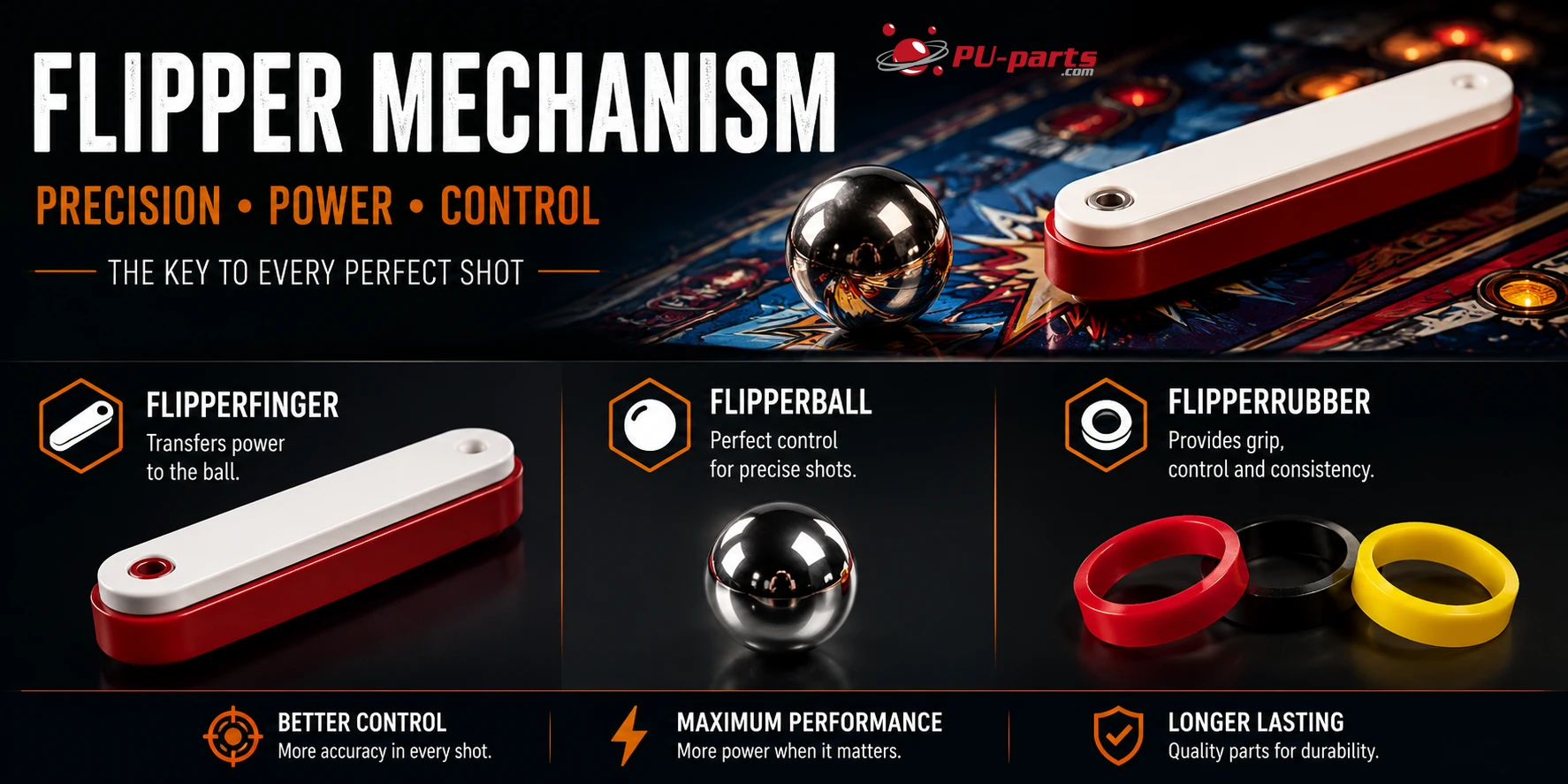
The flipper rubber sits on the visible flipper finger and has a significant influence on the contact between the finger and the ball. It protects the plastic of the flipper finger while also providing the necessary friction for ball control. Flipper rubbers are among the classic wear parts of a pinball machine. Due to constant contact with the steel ball, their surface changes over time. They can become dirty, harden, become smooth, or eventually tear.
The condition of the rubber directly affects gameplay. The material, hardness, and surface texture can alter how much the ball accelerates upon contact and how much grip the flipper finger provides. When replacing them, therefore, care should be taken to select the correct size and a design that matches the desired gameplay characteristics.
Should you oil or grease a pinball machine’s mechanism?
When mechanisms are stiff, it’s tempting to simply apply some oil or grease. However, especially around the plunger and coil sleeve, this is usually not a good solution. Oil and grease can trap dust, metal shavings, and other contaminants. Over time, this forms a layer that can actually hinder movement even more.
The plunger and coil sleeve should therefore always be kept clean and dry. If a sleeve is worn out or deformed, it should be replaced rather than made functional again through lubrication. For other bearing or contact points, however, the specific design or manufacturer’s specifications are always decisive. General lubrication of the entire pinball mechanism is not recommended.
When should a pinball mechanism be overhauled?
An overhaul may be advisable if a flipper has lost a significant amount of power, has an unusually large amount of play, no longer returns reliably, or behaves mechanically very differently from the second flipper finger. With older machines, it is often worthwhile to replace more than just a single visibly worn part. If several components have already accumulated significant wear, parts such as the plunger, link, coil sleeve, coil stop, bushings, and other wear parts can be inspected together and replaced as needed.
The goal of such an overhaul is not to make the flipper as “powerful” as possible. Rather, the key is to restore the function and movement characteristics intended by the manufacturer. A properly overhauled flipper finger should respond quickly, operate powerfully, return reliably, and have as little unwanted play as possible.
The flipper finger and flipper coil work together as a system
Technically speaking, the flipper finger cannot be viewed in isolation. Its function arises only through the interaction of the visible components on the playfield with the mechanical and electrical systems beneath it. The flipper coil is particularly important here. It provides the electromagnetic force that ultimately drives the flipper finger’s movement. At the same time, the plunger, coil sleeve, coil stop, mechanics, and—if applicable—the EOS switch determine how efficiently this force is actually transmitted to the flipper finger.
This is precisely why a supposed “flipper finger problem” can have its root cause in various places.
Can a flipper finger be too powerful?
Yes. A particularly powerful flipper isn’t automatically a well-adjusted one. The mechanics and the coil used are matched by the manufacturer to the specific machine. For example, if an unsuitable, more powerful coil is installed or the mechanics are modified, the gameplay can change significantly. Excessive pinball power can also put greater strain on other components. The ball hits targets, ramps, plastics, and other playfield elements faster. Especially in older machines, this can cause unnecessary wear and tear on components.
The goal of a repair or overhaul should therefore always be to restore the pinball machine to its intended performance, rather than making it as powerful as possible.
Why do the left and right flipper fingers have different strengths?
If the two main flippers on the same machine should theoretically operate similarly, but one feels significantly weaker, a direct comparison offers an excellent way to troubleshoot the issue.
First, compare the mechanics of both sides. Can both plungers be moved with similar ease when the machine is turned off? Do the sleeves, plungers, and coil stops show comparable wear? Are the mechanical connections properly assembled, and do both flipper fingers have a comparable starting position? The flipper rubbers should also be taken into account. Different materials or rubbers with significantly different levels of wear can alter the subjective feel of the game.
If no mechanical abnormalities are apparent, the electrical control system and—depending on the system used—the EOS switches can then be examined. Comparing the left and right sides is particularly helpful because, in the same machine, two very similar mechanical systems can often be compared directly with one another.
Why does a flipper finger sometimes work and sometimes not?
A flipper that sporadically fails to respond presents a different fault pattern than one that is consistently weak. If the flipper finger functions completely normally at times and then fails to respond at all or only responds irregularly, the cause should not be attributed solely to mechanical wear. Possible causes include, for example, the flipper button or its switch, connectors, cables, or the electrical control system. Depending on the manufacturer and system, other components may be involved in signal detection and solenoid control.
Here, too, a systematic troubleshooting approach is advisable: First, determine whether the fault is reproducible and under what conditions it occurs. Then, check step by step whether the flipper button’s input signal is reliably detected and whether the solenoid is activated accordingly. This diagnosis differs significantly from a flipper that triggers every time but generally lacks sufficient force.
Why does a flipper finger return slowly?
A flipper finger should return quickly to its starting position after the button is released. If this movement is noticeably slow, there is often increased mechanical friction or the return movement is otherwise impeded. Items to check include the plunger and coil sleeve, the flipper shaft and its guide, as well as the mechanical connections of the entire assembly. A damaged or unsuitable return spring can also affect the return behavior.
An interesting diagnostic method involves a manual test with the machine turned off. The mechanism should move smoothly through its intended range of motion and return reliably. Noticeable sticking or unusual resistance provides an important indication of a mechanical problem.
Why is a flipper finger too high or too low?
The resting position of a flipper finger is set during assembly. If the flipper finger or the underlying mechanism has been disassembled, this position must be correctly restored afterward. A misaligned flipper not only affects the appearance of the playfield. It can also affect the ball’s trajectory and certain shots.
Many playfields have small markings for aligning the flipper fingers. These are often located behind or below the flipper and indicate the position specified by the manufacturer. If such reference points are present, they should be used. If you’re unsure, the technical documentation for the specific machine can also be helpful.
When should a pinball rubber be replaced?
Pinball rubbers should not be replaced only after they crack. Their surface changes with increased use. Dirt and abrasion can accumulate, while the material may simultaneously become harder or smoother. Replacement is advisable at the latest when visible cracks, noticeable hardening, heavy soiling, or a noticeably smooth surface appear. How quickly a flipper rubber wears out depends heavily on the material, usage, and maintenance. Therefore, there is no universal replacement interval. However, for machines that are played regularly, it’s worth performing periodic visual inspections.
When replacing the rubber, the underlying pinball finger should also be cleaned and inspected for damage.
Cleaning the Pinball Finger – What Should You Keep in Mind?
Over time, dust, ball abrasion, and dirt from the playfield accumulate on the pinball finger and the rubber. Regular cleaning prevents these deposits from spreading unnecessarily.
The rubber can be removed from the finger for thorough cleaning or replacement. The plastic underneath can then be carefully cleaned. Harsh cleaners or unsuitable solvents should be avoided, especially on printed or delicate plastic parts. The appropriate cleaning method depends on the specific material.
While you’re at it, it’s also worth checking the condition of the finger itself. Cracks, damage, or a noticeably loose attachment should not be ignored.
When does the flipper finger itself need to be replaced?
The visible flipper finger typically lasts a very long time. Unlike the flipper rubber, spool sleeve, or various mechanical parts, it is not a component that must be replaced after a specific maintenance interval. However, replacement may be necessary if the plastic is cracked or otherwise damaged, if the shaft or its connection is problematic, or if the flipper finger can no longer be used reliably due to aging and heavy use.
When replacing it, keep in mind that not every flipper finger fits every machine. Length, shape, shaft, color, and construction can vary between manufacturers, machine generations, and models.
Trigger Finger: Common Problems at a Glance
| Symptom | Possible Cause |
|---|---|
| Flipper is consistently weak | Wear, friction, EOS/electrical issue, or voltage problem |
| Flipper stays in the raised position | Mechanism is binding or the coil remains energized , Return spring broken |
| Flipper returns slowly | Increased friction or a problem with the return mechanism |
| Flipper has excessive side-to-side play | Wear in the bushing, shaft, or mechanism |
| Flipper works only intermittently | Switch, wiring, connector, or control issue |
| One flipper is weaker than the other | Uneven wear, incorrect adjustment, or an electrical problem |
| Flipper is positioned incorrectly | Mechanism or flipper bat is not aligned correctly |
| Ball control feels different | Flipper rubber, adjustment, or mechanical wear |
The Pinball Finger as Part of an Integrated System
A reliably functioning pinball finger is the result of many coordinated components. The visible finger and its rubber pad are merely the parts that come into direct contact with the ball. The actual force is generated beneath the playfield. The pinball coil, plunger, coil sleeve, coil stop, bushing, lever mechanism, return mechanism, and—depending on the system—the EOS switch must all work together to ensure that pressure on the pinball button results in a fast and precise movement.
This understanding is particularly important when troubleshooting. “My flipper finger is weak” initially describes only the symptom—not yet the cause. Instead of immediately replacing individual parts, you should therefore examine the entire mechanism and check it step by step. When the mechanism is properly maintained and adjusted, the flipper finger responds immediately, moves smoothly, reliably reaches its intended end position, and returns cleanly to its starting position after the flipper button is released.
FAQ´s Flipper Bats
What is a pinball flipper and how does it work?
The flipper is the moving plastic bat on the playfield used to control and accelerate the ball. Its shaft is connected to the flipper mechanism underneath the playfield. When the flipper button is pressed, the flipper coil is energized. The plunger moves the mechanism, causing the flipper bat to rotate quickly and strike the ball.
Why is my pinball flipper weak?
A weak pinball flipper can have several causes. Common problems include a worn coil sleeve, worn plunger, worn coil stop, excessive play or friction in the mechanism, or problems with the EOS switch. Low supply voltage or poor electrical connections can also reduce flipper power.
Why does my pinball flipper stay up and not return?
If a flipper remains in the raised position after releasing the button, the mechanism may be binding. Possible causes include a dirty or damaged coil sleeve, a sticking plunger, a problem with the return mechanism or a binding flipper shaft. If the coil remains electrically energized, switch off the pinball machine and investigate the electrical fault to prevent the coil from overheating.
Why does my pinball flipper work intermittently?
An intermittent flipper can be caused by problems with the flipper button or switch, wiring, connectors or the electronic control system. If the problem occurs only occasionally, check whether the flipper button signal is detected reliably and whether the coil is correctly energized every time the button is pressed.
Why is one pinball flipper stronger than the other?
Unequal flipper strength can result from different levels of wear. Compare the coil sleeves, plungers, coil stops, bushings and mechanical connections on both sides. Different flipper rubbers, incorrect adjustment, EOS switch problems or differences in the electrical supply can also cause one flipper to feel weaker than the other.
How do you adjust a pinball flipper correctly?
A pinball flipper should be installed in the resting position specified by the manufacturer. Many playfields have small alignment marks or reference points near the flippers. After servicing or removing the flipper mechanism, its position should be checked carefully because even a small change in angle can affect ball control and shot trajectories.
Why does my pinball flipper have too much side-to-side play?
Excessive side-to-side play can indicate wear in the flipper shaft, playfield bushing or other parts of the flipper mechanism. A small amount of movement may be normal depending on the design. If the flipper feels noticeably loose or imprecise, the mechanism should be inspected for worn or damaged components.
Why does my pinball flipper return slowly?
A slow-returning flipper often indicates excessive friction or a problem with the return mechanism. Check the plunger, coil sleeve, flipper shaft, bushing and return mechanism. With the machine switched off, the mechanism can also be checked manually to determine whether it moves freely throughout its intended range of motion.
When should a pinball flipper mechanism be rebuilt?
A rebuild may be necessary when the flipper has noticeably lost power, develops excessive play, becomes sluggish or no longer returns reliably. On older mechanisms, the plunger, coil sleeve, coil stop, bushings, links and other wear components should be inspected together and replaced where necessary.
Which parts of a pinball flipper mechanism wear out?
Many of the typical wear parts are located underneath the playfield. Depending on the design, these can include the coil sleeve, plunger, coil stop, link, bushings and other mechanical components. The flipper rubber fitted around the visible flipper bat is also a common wear item.
When should pinball flipper rubbers be replaced?
Flipper rubbers should be replaced when they show cracks, significant hardening, damage or a noticeably smooth and worn surface. Because the rubber makes direct contact with the ball, its condition affects grip and ball control. Regular visual inspection is therefore recommended, especially on frequently played machines.
Should you lubricate a pinball flipper mechanism?
The plunger and coil sleeve should generally be operated clean and dry. Oil or grease can attract dust and metal particles, which may increase friction over time. A worn or damaged coil sleeve should therefore be cleaned or replaced rather than lubricated in an attempt to make the mechanism move more freely.
Can a bad flipper coil cause a weak pinball flipper?
Yes, but the coil is only one of several possible causes. A weak flipper can also result from mechanical wear, a damaged coil sleeve, a worn plunger, a worn coil stop or problems with the EOS switch. The complete flipper mechanism should therefore be checked systematically before replacing the coil.
Can you use any flipper bat as a replacement in a pinball machine?
No. Flipper bats can differ in length, shape, shaft design, color and construction depending on the manufacturer, machine generation and specific pinball model. Always use a flipper bat that is specified for or confirmed to be compatible with the particular machine.