Pinball Rubber - Sizes, Materials, Changes, and Their Impact on Gameplay
Pinball rubbers are among the classic wear parts of a pinball machine. They are located in numerous places on the playfield, where they perform various functions. They provide grip and rebound for the ball, protect components from direct impacts, and in some cases have a significant influence on how fast and dynamic a pinball game plays.
The rubbers on the two flipper fingers are particularly well-known. However, a typical pinball playfield features numerous other rubber elements. These include rubber rings, rubber sleeves, rubber caps, and bumpers, which—depending on the design—are used on posts, bumpers, slingshots, and other playfield elements.
As they age, these rubbers change. They can become harder, lose elasticity, get dirty, expand, or eventually tear. This affects more than just the appearance. Old or unsuitable pinball rubbers can noticeably alter the gameplay of a pinball machine. Anyone who maintains or restores their pinball machine should therefore also check the condition of the rubber parts regularly.
What Are Pinball Rubbers?
The term “pinball rubbers” refers to various elastic components used on the playfield of a pinball machine.
Their function depends on their specific location. For example, a rubber on a flipper finger is designed to enable controlled contact between the finger and the steel ball. In contrast, a rubber ring stretched between two posts reacts to the impact of the ball and returns a portion of the energy applied.
Other rubber parts serve primarily as buffers or protective elements. They prevent the pinball from striking hard metal or plastic components directly. Pinball rubbers are therefore by no means merely decorative components. They are a functional part of the playfield and its game mechanics.
What types of pinball rubbers are there?
Depending on the pinball machine and its intended use, different shapes and sizes are employed. Among the most important are:
Pinball Finger Rubbers
They are pulled over the actual pinball flipper rubber fingers and are under stress with nearly every ball contact. The rubber used influences, among other things, the grip between the ball and the pinball finger. Their condition, material, and surface can therefore have a noticeable impact on ball control. Especially on heavily played machines, the flipper finger rubbers should be checked regularly.
Rubber rings
Rubber rings can be found in numerous locations on the playfield. For example, they are stretched between posts and form elastic boundaries from which the ball can bounce off. They are available in various sizes. The correct size is important, as a ring that is too small will be stretched more tightly, while a ring that is too large may not achieve the intended tension.
Rubber Sleeves
Rubber sleeves are slid over corresponding posts or other components. There, they form an elastic contact surface for the ball and can simultaneously protect underlying components. Depending on the pinball model, different lengths and diameters are required.
Rubber Caps
Rubber caps are placed on designated components and primarily serve protective and cushioning functions. Here, too, selecting the correct type is crucial to ensure the cap fits securely and fulfills its intended function.
Impact Rubbers and Bumper Rubbers
In areas subject to heavy wear, special impact rubbers or rubber bumper elements are used around the bumpers. These components must withstand repeated contact with the ball and are therefore also typical wear parts.
Why do pinball machines have so many different types of rubber?
A pinball playfield consists of many different mechanical areas. In some places, the ball is meant to be strongly rebounded; in others, it is guided in a controlled manner; and in still others, it simply needs to be kept away from sensitive components.
The same rubber cannot be used everywhere for this purpose.
Size, shape, material, elasticity, and pre-tension all influence how a rubber element behaves upon contact with the ball. This is also an important consideration during restorations: the rubber configuration of a playfield should not be altered arbitrarily. Different sizes or materials can alter the gameplay behavior intended by the manufacturer.
How do pinball rubbers affect gameplay?
The influence of pinball rubbers is often underestimated. During a game, a steel ball repeatedly strikes elastic playfield elements at high speed. How much energy is absorbed or returned in the process depends, among other things, on the specific rubber.
An elastic rubber ring can bounce the ball back much more dynamically than an old, hardened ring. Similarly, a fresh flipper finger rubber may behave differently in terms of ball control than a heavily soiled or hardened one.
This can affect, among other things:
- Ball speed
- Rebound behavior
- Grip on the flipper finger
- Ball control
- Predictability of certain shots
- Noise produced upon ball contact
After a complete rubber replacement, a pinball machine that hasn’t been maintained for a long time may therefore play surprisingly differently.
This does not necessarily mean that something was done wrong. Rather, the previously installed rubbers may have aged so much that the machine’s performance had gradually changed over the years.
Why do old pinball rubbers harden?
Rubber ages. Heat, oxygen, light, mechanical stress, and environmental conditions affect the material over a long period of time. As a result, the rubber can gradually lose its elasticity. The surface becomes harder and, in some cases, smoother. With very old rubbers, cracks may also form, or the material may begin to disintegrate.
In a pinball machine, there’s an additional strain: the constant mechanical stress from the steel ball. Rubbers subjected to particularly heavy use can therefore wear out significantly sooner than rubber components that rarely come into direct contact with the ball.
How can you tell if pinball rubbers are worn out?
Not every worn-out rubber is immediately torn. Often, the aging process begins much earlier. Typical signs include:
| Condition | Possible Effect |
|---|---|
| Surface heavily soiled | Reduced grip and altered ball behavior |
| Rubber becomes hard | Changed elasticity and rebound behavior |
| Surface becomes smooth | Reduced grip on the flipper bat |
| Visible cracks | Rubber should be replaced soon |
| Rubber is stretched | Intended tension may be reduced |
| Rubber becomes brittle | Material may crack or deteriorate |
| Rubber is torn | Replacement required |
That’s why it’s especially important to thoroughly inspect all rubber parts, particularly on a newly purchased older pinball machine.
How often should you replace pinball rubbers?
There’s no set replacement schedule. A pinball machine in a commercial setting with many games played per day puts significantly more strain on its rubbers than a collector’s machine that’s played only occasionally. Therefore, the condition and usage of the machine are the most important factors.
Rubber fingers and heavily used playfield rubbers should be checked more frequently than areas with little ball contact. If cracks, hardening, heavy soiling, or noticeable deformation are visible, replacement is recommended. During a comprehensive maintenance or restoration of a machine that hasn’t been maintained for a long time, it may also be advisable not only to replace individual defective rubbers but to inspect the entire set of rubbers on the playfield.
Can pinball rubbers be cleaned?
Slightly dirty rubbers can certainly be cleaned, depending on the material. However, it’s important to distinguish between dirty and worn-out. Cleaning can remove deposits from the surface. However, it cannot restore aged material.
If a rubber is already hard, cracked, porous, or permanently deformed, replacement is usually the better solution. Pinball finger rubbers, in particular, can accumulate dirt relatively quickly. Since they are directly involved in ball control, it’s worth checking them regularly.
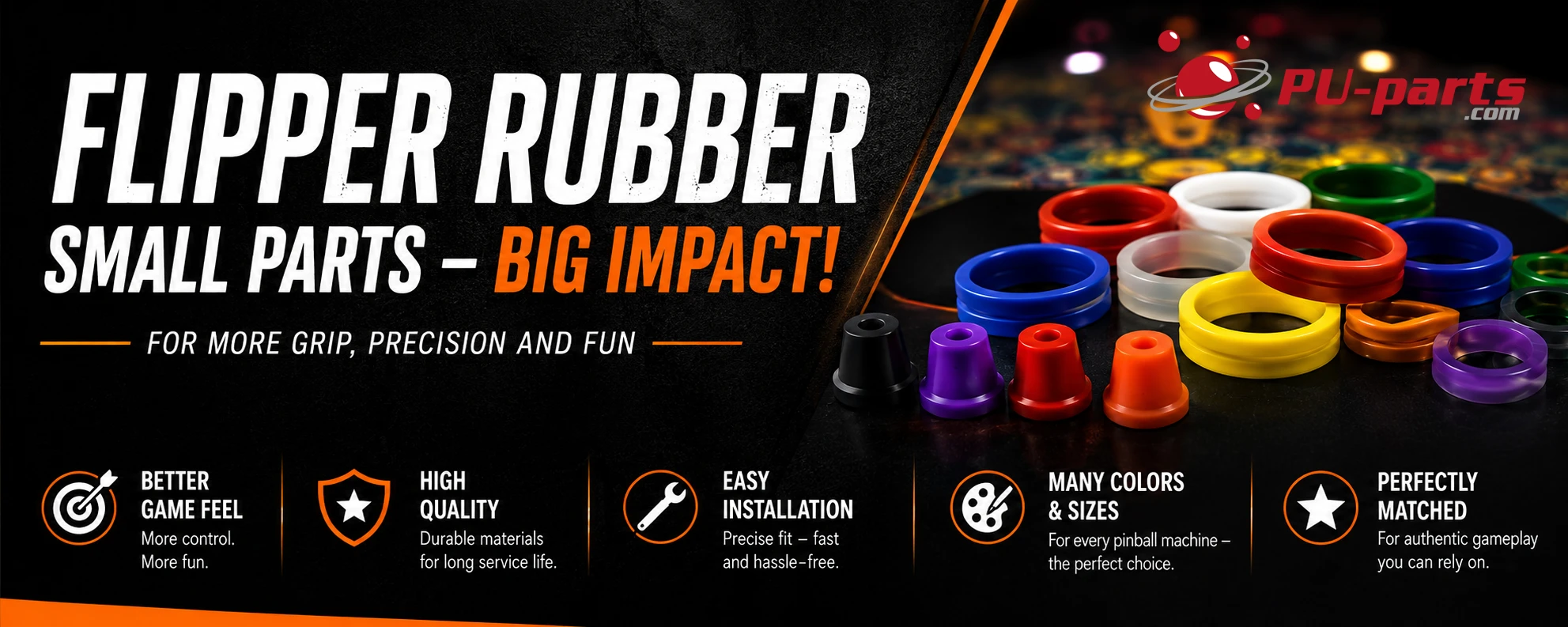
What size do I need for pinball rubbers?
Choosing the right size is one of the most important considerations when replacing pinball rubbers. You shouldn’t simply select a rubber ring based on whether it can somehow be stretched over the designated posts. The playfield’s design is engineered for specific sizes and, consequently, for a specific tension in the rubber.
A rubber ring that is too small will be stretched more than intended. This increases the tension, which can alter the ball’s rebound behavior and put additional strain on the material. A ring that is too large, on the other hand, may sit too loosely and lack the necessary pre-tension.
It is therefore safest to use the sizes specified for the respective pinball machine. Depending on the manufacturer and machine, information on this can be found, for example, in technical documentation, parts lists, or the specifications of a compatible rubber set. With older machines, you should not automatically assume that the rubbers currently installed are correct. Especially with used pinball machines, it is often unclear which parts a previous owner has already replaced or modified.
How are pinball rubbers measured?
For rubber rings, the size specification is particularly important. It’s important to note that size designations do not necessarily correspond to the outer diameter of a ring laid loosely on the table. Depending on the manufacturer and rubber type, different measurements may apply. Therefore, when taking measurements, you should always consider how the respective supplier defines its sizes.
Even more important: An old rubber ring is only of limited use as a template. Years of tension, aging, and material fatigue may have altered its original shape. Anyone looking for the correct size for a specific pinball machine should therefore, whenever possible, refer to the machine’s specified part or size information.
Why is the correct tension of a rubber ring important?
A rubber ring is normally mounted on the playfield with a specific amount of pre-tension. This creates the desired elastic response when the ball strikes it. If the tension is too high, the rebound behavior may change. Additionally, the rubber and, if applicable, the involved posts are subjected to greater stress.
If, on the other hand, the tension is too low, the area may react significantly softer than intended. The correct size of a pinball rubber is therefore not just a matter of installation; it is part of the playfield’s fine-tuning.
What role does the hardness of pinball rubbers play?
In addition to size and shape, material hardness also plays a role. Elastic materials of varying hardness can react differently upon contact with the ball. Softer materials can provide more grip and deform more upon impact. Harder variants can feel more direct and produce different rebound behavior.
However, it’s not possible to make a blanket statement that “soft” or “hard” is fundamentally better. The decisive factor is the desired gameplay behavior or what the manufacturer intended. Especially with the flipper fingers, a change in material can be clearly noticeable. There, the contact surface directly determines how the ball is accelerated and controlled by the flipper finger during the shot.
Classic Pinball Rubbers or Modern Alternatives?
In addition to classic rubber compounds, modern elastic materials are also available for many pinball machines today. These include, for example, various silicone or other polyurethane compounds. These materials can differ in terms of surface texture, elasticity, durability, resistance to dirt, and grip.
However, this does not mean that a modern alternative is automatically the better choice for every machine. For a restoration that remains as true to the original as possible, for example, the classic version may be preferred. On the other hand, those who prioritize durability, maintenance, or gameplay behavior differently can consciously opt for an alternative material.
It’s important to understand:
The material of a pinball rubber can alter the gameplay.
A replacement should therefore not be decided solely based on color or appearance.
Do silicone rubbers change the gameplay of a pinball machine?
They can.
Depending on the manufacturer, material composition, and hardness, the grip and rebound may differ from those of classic rubbers. Such differences can be particularly noticeable in areas with frequent ball contact. This applies, for example, to pinball fingers, slingshots, or tightly tensioned rubber rings on the playfield.
Anyone who wants to keep their pinball machine as close as possible to its original feel should therefore keep in mind that material changes have more than just visual effects. Conversely, a player may also deliberately choose a specific material because they prefer its properties. There is therefore no single “best pinball rubber” for every machine and every player.
What color should pinball rubbers be?
Pinball rubbers are available in various colors. Classic machines were equipped with different colors or designs depending on the manufacturer and era. During restorations, the original color scheme can therefore be an important criterion.
Today, however, color is often used as a design element as well. Matching rubbers can complement the colors of the artwork and visually transform the entire playfield. However, it’s important to note that color and material properties are not necessarily independent of one another. Depending on the manufacturer, different versions may also have different material compositions or degrees of hardness.
Anyone who is simply changing the color should therefore still check whether the technical properties are suitable for the intended use.
How do you replace pinball rubbers?
The exact effort required depends heavily on where the rubber in question is located on the playfield. A flipper finger rubber is relatively easy to replace. Other rubber rings, however, are sometimes located under plastics, ramps, or other playfield structures. To access them, other components may first need to be carefully removed. As a general rule, the pinball machine should be turned off and unplugged from the power source before working on the playfield.
When replacing the rubbers, a systematic approach is recommended:
1. Document the position and layout of the existing rubbers.
2. For more complex areas, take photos before disassembly.
3. Carefully remove the old rubbers.
4. Inspect and clean the posts and adjacent areas.
5. Install the appropriate new rubbers.
6. Check that the rubbers are seated correctly in their intended positions.
7. Reinstall any removed plastics, ramps, or other components correctly.
8. Perform a final visual inspection before playing.
Photos taken before disassembly are particularly helpful for more complex playfields. After removing several rings, it’s not always immediately obvious between which posts a particular rubber was originally stretched.
🔧 Workshop Tip: Pinball rubbers can be briefly soaked in warm water before installation. The heat temporarily softens and stretches the material, making it easier to pull particularly tight rubber rings or other pinball rubbers over the designated playfield parts and install them.
Should you replace individual pinball rubbers or an entire set at once?
That depends on the condition of the machine.
If only a relatively new flipper finger rubber is damaged, replacing that single rubber may be entirely sufficient. The situation is different for an older machine whose rubber components haven’t been replaced in many years. If several rubbers are already hard, dirty, or porous, other rubber parts are often in a similar state of deterioration.
In this case, a complete rubber set for the specific pinball model may be a good idea.
The advantage isn’t just that many rubbers can be replaced in a single operation. A matching set also makes it easier to assemble the various sizes required. Nevertheless, even when purchasing a rubber set, you should check which parts are actually included and for which machine version or configuration the set is intended.
Should you clean the playfield at the same time as replacing the rubbers?
This is often a good idea.
When plastics or other playfield components are disassembled for a comprehensive rubber replacement anyway, areas become accessible that are difficult to reach during normal maintenance.
This provides a good opportunity to remove dust, ball abrasion, and other debris. You should also check whether deposits have formed under old rubbers or whether adjacent posts and plastic parts are damaged. A complete rubber replacement can therefore be usefully combined with a thorough playfield cleaning and visual inspection.
Can dirty pinball rubbers also dirty the playfield?
Yes. Dust, abrasion, and other debris accumulate on the rubbers during gameplay. Through constant contact with the ball, these particles can then be transferred to other areas of the playfield.
This is often particularly evident with heavily worn rubbers.
The ball itself also plays a role: It moves continuously between rubbers, metal parts, ramps, and the playfield surface and can spread dirt throughout the entire machine. Regular cleaning and the timely replacement of heavily worn rubbers are therefore essential parts of proper playfield maintenance.
Can the wrong pinball rubbers cause damage?
An incorrect size or improper installation can, at the very least, lead to undesirable stress. For example, if a rubber ring that is significantly too small is stretched tightly between two posts, greater forces act on the material and the components involved. At the same time, the behavior upon ball contact changes. Conversely, a rubber ring that is too large may sit too loosely, slip out of place, or fail to perform its intended function correctly.
That’s why, even with a seemingly simple wear part:
The correct size and position are more important than simply having any rubber ring installed.
Why does a pinball rubber band fly off during play?
If a rubber band regularly comes loose, you shouldn’t simply reinstall the same one. Possible causes include the wrong size, an unsuitable shape, improper installation, or a problem with the components that guide or hold the rubber band in place. An old rubber that has stretched significantly may also have lost its original tension. For flipper finger rubbers, you should also check whether the specific model fits correctly on the respective flipper finger.
What should you check on a pinball machine that has been out of use for a long time?
If a pinball machine has been idle for several years or even decades, the condition of the rubbers should be checked before resuming intensive play. A rubber may initially appear intact but may already be significantly hardened. As soon as it is subjected to heavy stress again, cracks may form or the material may break.
The following should be checked in particular:
- Pincher rubber
- Highly tensioned rubber rings
- Rubber sleeves
- Rubber caps
- Rubbers on slingshots
- Rubbers in the bumper area
- Hard-to-reach rubbers under playfield structures
If the maintenance history is unknown, a thorough inspection is more advisable than simply replacing obviously cracked parts.
Pinball rubbers and flipper fingers go hand in hand
The importance of the correct rubber on the flipper finger is particularly evident.
FAQ - Knowledge Pinball Rubbers
Why are pinball rubbers so important for the physics of a pinball machine?
Pinball rubbers influence how much energy the ball absorbs and receives back on impact. They therefore affect rebound, direction and ball speed. For this reason, rubbers are an important part of the way a playfield is designed to behave and are much more than simple protective components.
Why are some pinball rubbers under more tension than others?
The amount of tension depends on the mounting position and the design of the playfield. Some rubbers are intended to produce a more dynamic rebound, while others primarily guide or cushion the ball. Different rubber sizes, shapes and levels of tension are therefore deliberately used throughout a pinball playfield.
Can warm water make pinball rubbers easier to install?
Yes. Pinball rubbers can be placed briefly in warm water before installation. The warmth temporarily makes the material softer and more flexible, which can make tight-fitting rubbers easier to stretch over posts or other designated playfield components.
Should I turn off my pinball machine before replacing the rubbers?
Yes. The pinball machine should be switched off and disconnected from the power supply before working on the playfield. Depending on the machine, plastics, ramps or other components may need to be removed during a rubber replacement, so the machine should remain disconnected while the work is being carried out.
Why should I take photos of the playfield before removing the old rubbers?
On complex playfields, it may not be obvious where every rubber was originally installed once several have been removed. Photos taken from different angles document the position, routing and installation of the rubbers and can make correct reassembly considerably easier.
What tools do I need to replace pinball rubbers?
Very little tooling may be required for easily accessible rubbers. Depending on the playfield, however, screwdrivers, nut drivers or other tools may be needed to remove plastics, ramps and brackets. Always use suitable tools to avoid damaging surrounding playfield components.
Do I always have to remove ramps and plastics when replacing pinball rubbers?
No. Easily accessible rubbers can often be replaced directly. However, many pinball machines have rubber rings located underneath plastics, ramps or other playfield assemblies. The amount of disassembly required therefore depends entirely on the particular machine and the location of the rubber.
Why does black or dark rubber residue build up on a pinball playfield?
Continuous ball contact and mechanical stress can release very small particles from rubbers and other components. Combined with dust and other contamination, these particles can contribute to the typical dark residue found on a playfield. Regular cleaning helps reduce this buildup.
Can room temperature affect the behavior of pinball rubbers?
Elastic materials change their properties with temperature. Cold rubbers can feel harder, while warmer rubber may become more flexible. Under normal indoor conditions these differences are usually relatively small, but they can become more noticeable when a pinball machine is exposed to significant temperature changes.
Why doesn't a pinball playfield use the same type of rubber everywhere?
Different areas of a playfield perform different functions. Some rubbers are designed to create a strong rebound, while others guide the ball, cushion impacts or protect specific components. Their dimensions, shape, material and tension can therefore vary according to their intended function.
What does grip mean when talking about pinball rubbers?
Grip describes the traction between the rubber and the pinball. This is particularly important on flipper rubbers because it influences how precisely the ball can be caught, controlled and accelerated by the flipper bats. Dirt, wear and the condition of the rubber can all affect grip.
Can pinball rubbers affect how loud a pinball machine sounds during play?
Yes. Elastic rubber components cushion direct contact between the steel pinball and hard playfield components. If a required rubber is missing or has become severely hardened, ball impacts can sound harder and louder than they would with an intact and elastic rubber.
What else should I inspect when replacing pinball rubbers?
A rubber replacement is a good opportunity to inspect posts, screws, plastics, sleeves, brackets and other nearby playfield components for wear or damage. Areas that are normally difficult to reach can also be cleaned before the new rubbers are installed.
Why should I test the pinball machine after replacing all the rubbers?
After installation, check that all rubbers are correctly positioned and that no ramps, plastics, switches or moving mechanisms are obstructed. A short functional test can help identify installation errors or playfield components that may have been accidentally moved during the work.